
Alexis Degrenier – ‘Anatomie de la Mélancolie’
BIO
Solo for percussion, voice, small electronic devices, and electric fireflies.
Following his percussion solo La mort aura tes yeux (“La mort aura tes yeux” first album) and the concert series ‘Membres miroirs, mouvements fantômes’, Alexis Degrenier embarks on a new cycle of solo creation, also leading toward the recording of a forthcoming album. This project extends his research into the hindered body, sonic affects, and the relationship between gesture and technology, sustaining the tension between presence and absence, light and shadow, speech and silence.
After exploring these questions through three duos with Clara Lévy (Dispars), Radwan Ghazi Moumneh (‘Parler avec les mots des autre’), and Yann Gourdon (‘Pas est le Saut‘), Degrenier returns to solo performance to question, in a more radical way, the plasticity of his instrumentarium, making it more mobile, fragile, and ramified. The set combines percussion and electronic devices: organelle, transducers, microphones, pedals — all sonic prostheses that transform gesture and unfold a figure of the extended body.
At the origin of this project lies the obsessive refrain of Melencolia I by Albrecht Dürer, and its strange, highly symbolic and enigmatic scene, where the motionless time of melancholy coexists with light and the dawn of an open space — an “Ouvroir,” as Chris Marker liked to call it.
The tools of the creative angel stand alongside suspended, multifaceted temporalities, the magic square (astronomy), the animal, and geometry represented by that strange and mysterious central polyhedron.
From this philosophical vision to these mathematical elements, the work seeks to expose an affect questioned since Antiquity, and all too present in our own times.
Thus, this solo explores the figure of “melancholy as the light of immortality” through an arrangement of objects, lights, figures of time such as the metronome-clocks from the previous solo, and small electronic devices, destabilizing the very act of creation through the position of the hindered body.
This solo examines the paradox of an exhausted body that becomes saturated. The aim is to inhabit and experience this setup anew with each performance, exploring micro-sounds, over-amplification, and the tension between precision and overflow. The voice will also open another field of listening: cries, breaths, stammering, inverted language — an animal voice struggling with the meaning of the world surrounding it. From night comes dawn, and from melancholy comes light. To turn this sorrowful affect into a vital force once it has been traversed.
This work extends a theoretical reflection developed through his teaching at the École supérieure d’art de Clermont Métropole (“Lines of Rupture and Effects of Affect”), exploring the idea that musical rupture “connects as much as it separates,” from Pythagoras to Kendrick Lamar, passing through György Ligeti’s idea of the continuum, a marker of an “aesthetics of rupture.”
LINE UP :
Alexis Degrenier : prepared floor tom, snare drum, two suspended cymbals, objects (metal, wood, stones), electronics (organelle, effects pedals, bone-conduction speaker), reactive lighting system responding to percussion, battery-powered small incandescent lights, three microphones.
Lighting design : Édouard Suffrin
co-production by GMEA – Centre National de Création Musicale, Muse en Circuit – Centre National de Création Musicale, GRAME – Centre National de Création Musicale, and Murailles Music.
LINKS
TAGS
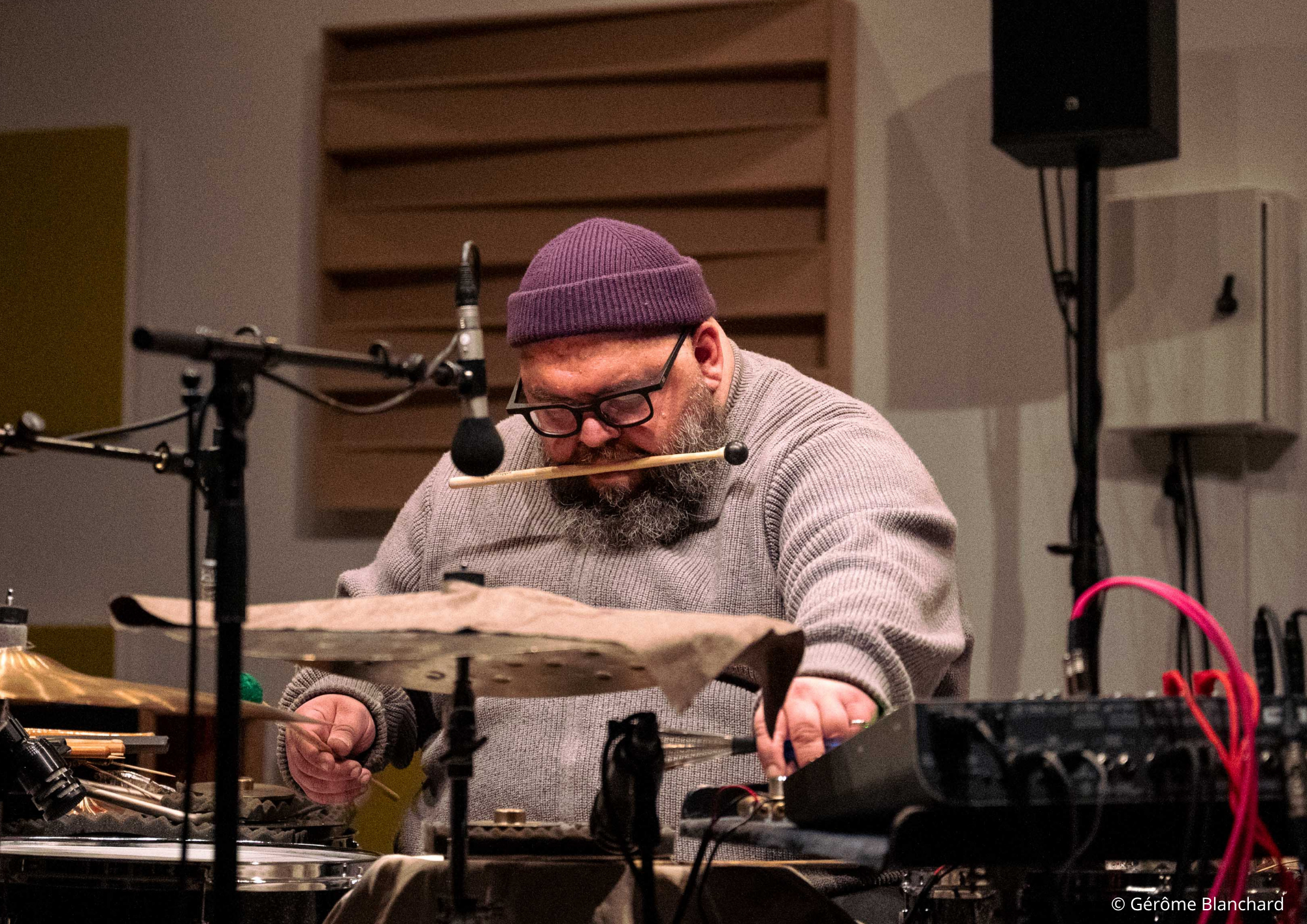

'ECHOS' - Alexis Degrenier 'battre le temps' (beating time)
DISCOGRAPHIE
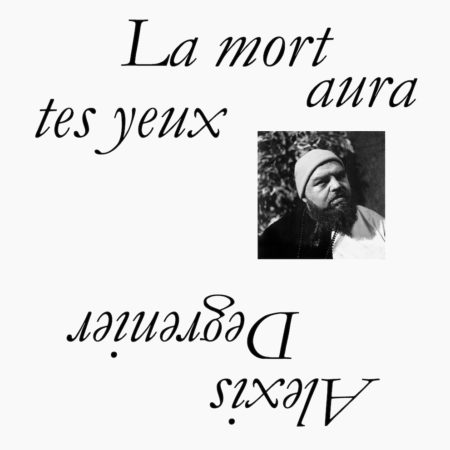
La mort aura tes yeux
Murailles Music / Standard In-Fi2022
LP / Digital
Buy
events
-
'ECHOS' - Alexis Degrenier 'battre le temps' (beating time)
BIO
Solo for percussion, voice, small electronic devices, and electric fireflies.
Following his percussion solo La mort aura tes yeux (“La mort aura tes yeux” first album) and the concert series ‘Membres miroirs, mouvements fantômes’, Alexis Degrenier embarks on a new cycle of solo creation, also leading toward the recording of a forthcoming album. This project extends his research into the hindered body, sonic affects, and the relationship between gesture and technology, sustaining the tension between presence and absence, light and shadow, speech and silence.
After exploring these questions through three duos with Clara Lévy (Dispars), Radwan Ghazi Moumneh (‘Parler avec les mots des autre’), and Yann Gourdon (‘Pas est le Saut‘), Degrenier returns to solo performance to question, in a more radical way, the plasticity of his instrumentarium, making it more mobile, fragile, and ramified. The set combines percussion and electronic devices: organelle, transducers, microphones, pedals — all sonic prostheses that transform gesture and unfold a figure of the extended body.
At the origin of this project lies the obsessive refrain of Melencolia I by Albrecht Dürer, and its strange, highly symbolic and enigmatic scene, where the motionless time of melancholy coexists with light and the dawn of an open space — an “Ouvroir,” as Chris Marker liked to call it.
The tools of the creative angel stand alongside suspended, multifaceted temporalities, the magic square (astronomy), the animal, and geometry represented by that strange and mysterious central polyhedron.
From this philosophical vision to these mathematical elements, the work seeks to expose an affect questioned since Antiquity, and all too present in our own times.
Thus, this solo explores the figure of “melancholy as the light of immortality” through an arrangement of objects, lights, figures of time such as the metronome-clocks from the previous solo, and small electronic devices, destabilizing the very act of creation through the position of the hindered body.
This solo examines the paradox of an exhausted body that becomes saturated. The aim is to inhabit and experience this setup anew with each performance, exploring micro-sounds, over-amplification, and the tension between precision and overflow. The voice will also open another field of listening: cries, breaths, stammering, inverted language — an animal voice struggling with the meaning of the world surrounding it. From night comes dawn, and from melancholy comes light. To turn this sorrowful affect into a vital force once it has been traversed.
This work extends a theoretical reflection developed through his teaching at the École supérieure d’art de Clermont Métropole (“Lines of Rupture and Effects of Affect”), exploring the idea that musical rupture “connects as much as it separates,” from Pythagoras to Kendrick Lamar, passing through György Ligeti’s idea of the continuum, a marker of an “aesthetics of rupture.”
LINE UP :
Alexis Degrenier : prepared floor tom, snare drum, two suspended cymbals, objects (metal, wood, stones), electronics (organelle, effects pedals, bone-conduction speaker), reactive lighting system responding to percussion, battery-powered small incandescent lights, three microphones.
Lighting design : Édouard Suffrin
co-production by GMEA – Centre National de Création Musicale, Muse en Circuit – Centre National de Création Musicale, GRAME – Centre National de Création Musicale, and Murailles Music.
LINKS
DISCOGRAPHIE
La mort aura tes yeux
Murailles Music / Standard In-Fi2022
LP / Digital
Buy